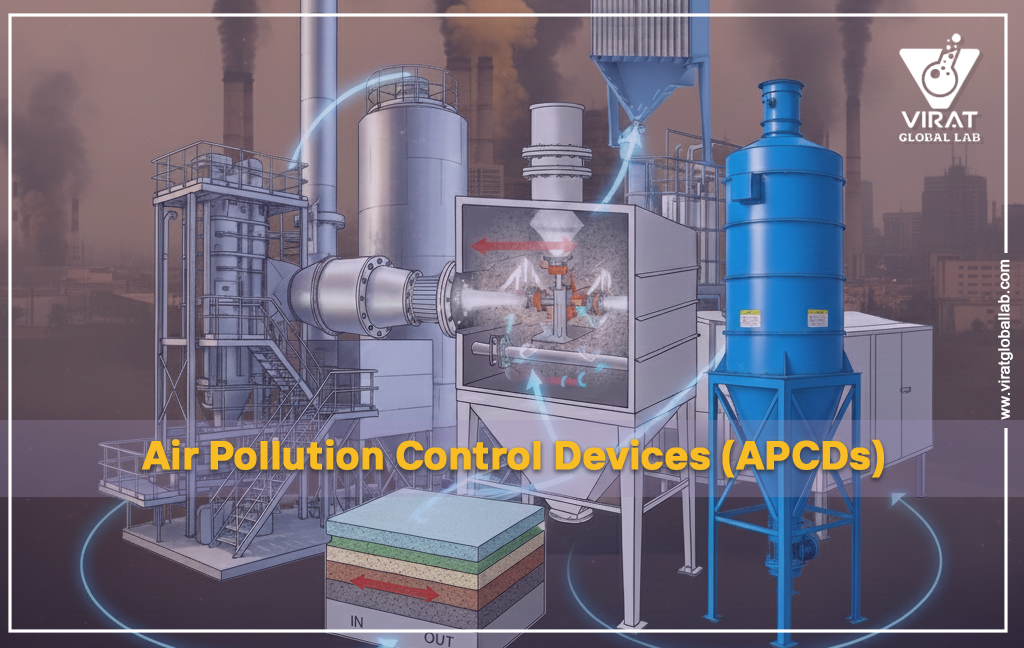
Air pollution control is a critical component of industrial environmental management, especially in sectors involving combustion, chemical reactions, and bulk material processing. Air Pollution Control Devices (APCDs) are engineered systems designed to reduce or eliminate pollutants from gas streams before their discharge into the atmosphere. They ensure compliance with emission standards mandated under national and state environmental regulations.
1. Cyclone Separators
Cyclone separators function as primary particulate control systems based on centrifugal separation principles. When dust-laden gas enters the cyclone body, it is forced into a high-velocity spiral motion, generating radial inertia that drives heavier particulates toward the cyclone walls. These particles subsequently migrate downward into a collection hopper, while the cleaned gas exits through the vortex finder. Due to their mechanical simplicity, durability, and low maintenance requirements, cyclone separators are widely deployed as pre-cleaners in cement plants, metallurgical industries, foundries, and woodworking units.
2. Baghouse Filters (Fabric Filters)
Baghouse filtration systems represent one of the most efficient technologies for fine particulate removal. Contaminated gas passes through an array of fabric filter bags made from materials such as polyester, aramid, or PTFE. Particulates are captured on the fabric surface, forming a dust cake that further enhances filtration efficiency. Automatic cleaning mechanisms such as pulse-jet air bursts or mechanical shaking periodically remove accumulated dust to maintain optimal pressure drop. Baghouses are indispensable in boilers, cement kilns, chemical reactors, and industries requiring particulate emission levels below regulatory thresholds.
3. Electrostatic Precipitators (ESPs)
Electrostatic precipitators employ electrostatic charging and collection mechanisms to remove fine particulates from gas streams. High-voltage discharge electrodes impart a unipolar charge to suspended particles, which are subsequently attracted to grounded collecting plates under an imposed electrostatic field. The collected dust is periodically removed through rapping or vibration. ESPs offer extremely high removal efficiency for submicron particles and are extensively used in thermal power plants, petroleum refineries, pulp and paper mills, and large-scale process heaters.
4. Wet Scrubbers
Wet scrubbers provide simultaneous control of gaseous pollutants and particulate matter. These systems bring the contaminated gas stream into direct contact with a scrubbing liquid typically water or an alkaline reagent facilitating pollutant removal through mechanisms such as absorption, chemical neutralization, and impaction. Variants like venturi scrubbers provide high-energy particulate capture, while packed bed scrubbers are optimized for acidic gas removal, including SO?, HF, HCl, and NH?. Wet scrubbers are extensively deployed in fertilizer plants, acid production units, chemical manufacturing operations, and metallurgical processes.
5. Activated Carbon Adsorbers
Activated carbon adsorbers are used for the removal of volatile organic compounds (VOCs), odorous emissions, and trace-level toxic gases. These systems rely on physical adsorption, wherein pollutant molecules adhere to the high surface area of activated carbon granules. Their effectiveness makes them suitable for pharmaceutical production, solvent-based coating operations, fuel storage facilities, and petrochemical plants where VOC control is mandatory.
6. Thermal Oxidizers
Thermal oxidizers eliminate organic vapours and hazardous gases by oxidizing them at elevated temperatures, typically between 750°C and 1,100°C. Pollutants undergo thermal decomposition and are converted into CO? and H?O. Energy-efficient variants such as regenerative thermal oxidizers (RTOs) and recuperative oxidizers incorporate heat exchange systems to reduce operational fuel demand. Thermal oxidizers are widely used in printing and packaging lines, chemical reactors, petrochemical processes, and high-VOC industrial applications.
7. Biofilters
Biofilters utilize microbial degradation to treat gas streams containing biodegradable organic compounds. Air is passed through a biologically active medium often compost, peat, or engineered bio-media where pollutants dissolve into the biofilm and are metabolized by microorganisms. Biofilters are particularly effective for odour control and VOC reduction in wastewater treatment facilities, food processing units, composting operations, and solid waste management plants.
8. Mist Collectors
Mist collectors are specialized APCDs used to capture fine oil mist, coolant aerosols, and condensable vapours generated during machining, grinding, and CNC operations. These systems may employ mechanical impaction, coalescing filter elements, or electrostatic modules to remove aerosols and protect worker health while maintaining compliant indoor air quality.
9. Catalytic Converters
Catalytic converters facilitate the oxidation of carbon monoxide and hydrocarbons and the reduction of nitrogen oxides using catalytic surfaces coated with noble metals such as platinum, palladium, or rhodium. While widely recognized in automotive emission control, catalytic converters are also used in stationary engines, DG sets, and small industrial combustion units to achieve regulatory emission reductions.
Conclusion
Air Pollution Control Devices form an essential part of industrial emission management strategies. Their appropriate selection, engineering design, and integration into process systems are critical for maintaining compliance with CPCB and SPCB emission norms, promoting workplace safety, and reducing environmental impacts. A comprehensive understanding of pollutant characteristics, gas flow dynamics, and regulatory requirements is vital to ensure optimal APCD performance and long-term operational reliability.
Effective air pollution control is a critical component of industrial environmental management, and maintaining compliance with emission norms requires accurate data, robust monitoring, and scientifically validated assessments. To support industries in achieving these objectives, Virat Global Lab (a division of Aseries Envirotech India Private Limited) delivers comprehensive, accredited environmental testing and compliance solutions.
Our laboratory specializes in stack emission monitoring, ambient air quality assessment, APCD performance evaluation, source apportionment studies, and all regulatory testing required under CPCB and SPCB guidelines. Equipped with advanced analytical instruments and supported by experienced environmental professionals, Virat Global Lab ensures precise data generation, technical clarity, and actionable insights that help industries optimize their air pollution control systems.
Whether your facility needs routine compliance monitoring, third-party verification, or expert guidance in strengthening its emission management strategy, Virat Global Lab is committed to delivering reliable, high-quality technical support.
Enhance your compliance. Strengthen your environmental stewardship
with Virat Global Lab (a division of Aseries Envirotech India Private Limited) and take a proactive step toward cleaner, safer, and fully compliant industrial operations.
At Virat Global Lab (A Division of Aseries Envirotek India Pvt. Ltd.), we invite businesses, Industries and institutions across various sectors to explore the benefits of partnering with us for their environmental testing and analytical needs.