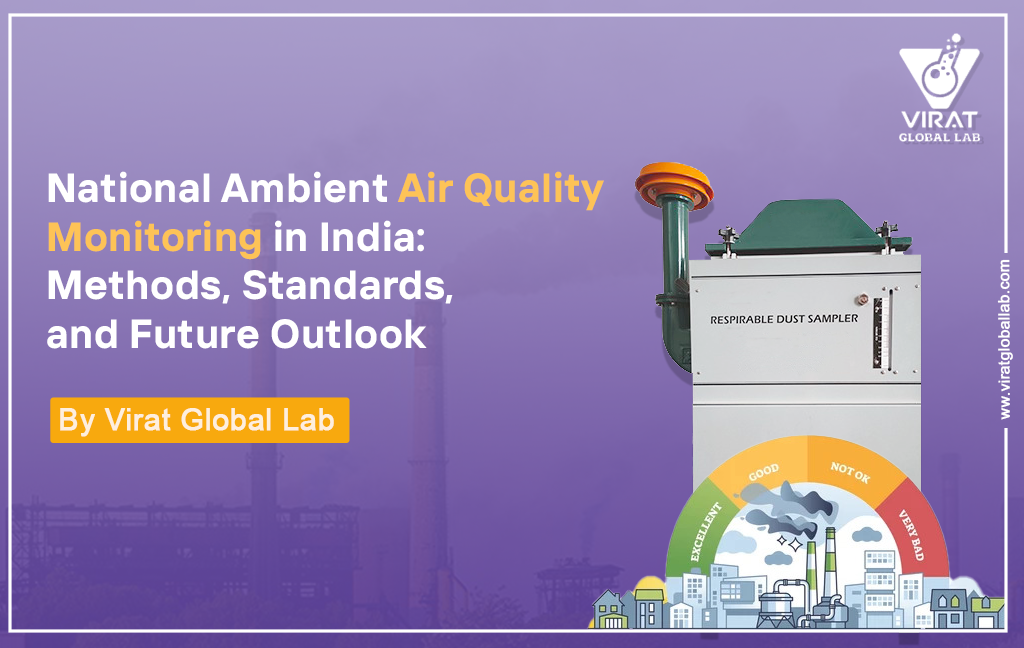
Air is the invisible lifeline that sustains all forms of life. Yet, in 2025, India continues to struggle with severe air quality challenges that directly affect human health, ecosystems, and economic productivity. Ambient Air Monitoring plays a crucial role in understanding pollution trends, enforcing regulations, and guiding policy actions.
Why Ambient Air Monitoring Matters
Ambient air monitoring is the process of measuring pollutants present in outdoor air to assess their compliance with prescribed standards. It provides real-time and long-term data to:
In India, ambient air monitoring is carried out in line with guidelines laid down by the Central Pollution Control Board (CPCB) under the Ministry of Environment, Forest and Climate Change (MoEF&CC).
CPCB Testing Methods for Ambient Air Quality
CPCB prescribes specific testing methods for each pollutant under the National Ambient Air Quality Standards (NAAQS), 2009. These methods are based on scientific accuracy, cost-effectiveness, and feasibility for Indian conditions.
Key Pollutants and CPCB Testing Methods
CPCB operates the National Air Quality Monitoring Programme (NAMP) through a network of manual stations and Continuous Ambient Air Quality Monitoring Stations (CAAQMS) across urban and industrial clusters.
CPCB Ambient Air Quality Limits
The NAAQS, 2009, specifies the following annual average limits (µg/m³):
|
Pollutant |
Annual Limit |
24-hour Limit |
|
PM10 |
60 µg/m³ |
100 µg/m³ |
|
PM2.5 |
40 µg/m³ |
60 µg/m³ |
|
SO2 |
50 µg/m³ |
80 µg/m³ |
|
NO2 |
40 µg/m³ |
80 µg/m³ |
|
O3 |
180 µg/m³ (1hr) |
100 µg/m³ (8-hr) |
|
CO |
4 mg/m³ (1hr) |
2 mg/m³ (8-hr) |
|
Lead |
0.5 µg/m³ |
1.0 µg/m³ |
India’s Air Pollution Scenario in 2025
Despite policy interventions, India remains one of the most polluted countries in the world. According to early 2025 data from CPCB and independent monitoring:
According to the Centre for Research on Energy and Clean Air (CREA), air quality across India showed notable improvement in July 2025, largely due to increased rainfall.
NCAP vs Non-NCAP Cities
AQI Categories (National)
Most Polluted Cities in July 2025
Cleanest City
Megacities
But “According to CPCB’s 2025 NAMP data and the IQAir World Air Quality Report 2025, Indian cities like Delhi, Ghaziabad, and Patna remain among the most polluted globally, with annual PM2.5 levels exceeding both India’s NAAQS and WHO limits.”
Way Forward
Conclusion
Ambient air monitoring is not just a regulatory tool—it is a public health safeguard. While India has developed a robust monitoring framework under CPCB and NAMP, the 2025 reality shows that enforcement, stricter limits, and innovative solutions are urgently needed. The path to cleaner air will require coordinated efforts from government, industry, and citizens alike.
At Virat Global Lab, a division of Aseries Envirotek India Private Limited, we are committed to safeguarding the air you breathe.
With advanced CPCB-approved testing methods, state-of-the-art monitoring equipment, and expert scientists, we help industries, institutions, and communities stay compliant while protecting public health.
Whether it’s ambient air monitoring, source emissions, or compliance reporting, we provide accurate, reliable, and NABL-accredited services across India.
Take a step towards cleaner air today.
Connect with Virat Global Lab for your ambient air testing and compliance needs — because healthier air means healthier lives.
At Virat Global Lab (A Division of Aseries Envirotek India Pvt. Ltd.), we invite businesses, Industries and institutions across various sectors to explore the benefits of partnering with us for their environmental testing and analytical needs.