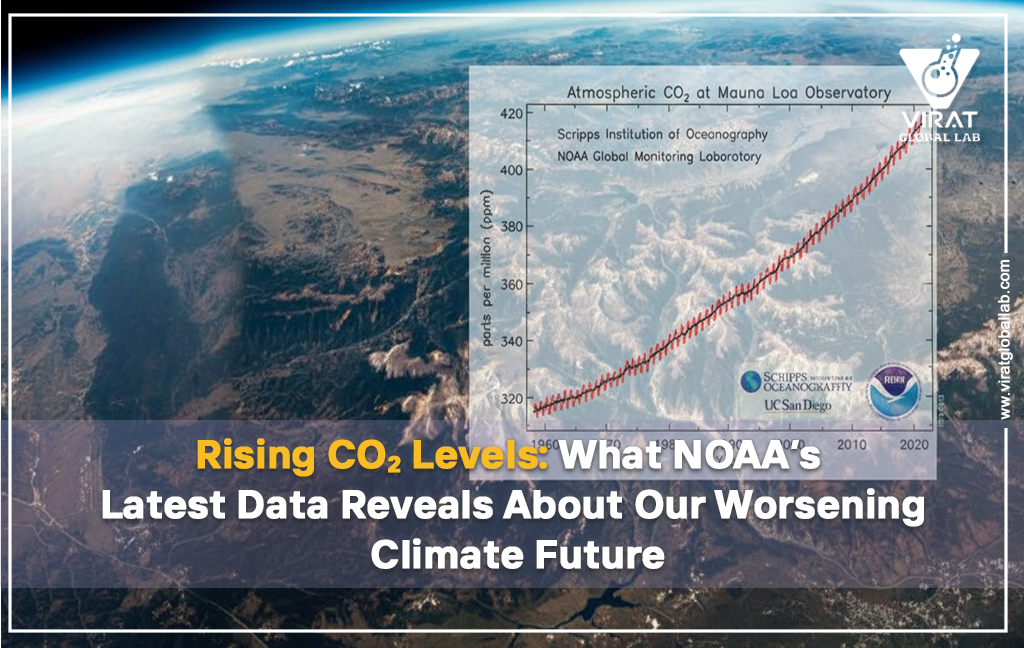
Global carbon dioxide (CO2) emissions continue to rise at an alarming pace, and the latest observations from the NOAA Global Monitoring Laboratory paint a stark picture of how fast the planet is warming. From long-term annual CO2 growth rates to monthly and weekly averages at the world’s most important baseline observatory Mauna Loa the data confirms one thing clearly: Earth’s atmosphere is accumulating heat-trapping gases faster than ever before.
This blog breaks down the long-term trends, explains the scientific concern, and highlights what must be done now to avert irreversible climate disruption.
A Rapidly Rising Curve: Decades of CO2 Growth
When NOAA began continuous atmospheric CO2 monitoring in 1959, annual growth rates ranged between 0.5–1.0 ppm. Today, growth rates have tripled, with several recent years adding more than 2.5–3.0 ppm of CO2 to the atmosphere.
The shift is dramatic. In 2024, the global CO2 growth rate reached 3.72 ppm, one of the highest ever recorded. Long-term data shows sharp spikes during El Niño years (1998, 2016, 2024), but the underlying trend is unmistakable: even in normal years, CO2 levels rise faster than the previous decade.
This sustained acceleration reveals how human activities especially fossil fuel combustion, deforestation, industrial processes, and agricultural emissions continue to outweigh the planet’s natural ability to absorb carbon.
Monthly CO2 Levels: Breaking New Records Every Year
NOAA’s global monthly CO2 data offers another perspective on how quickly the atmosphere is changing. In August 2024, global CO2 averaged 420.26 ppm. By August 2025, this value had climbed to 422.95 ppm.
This rise in just one year 2.69 ppm is consistent with the long-term accelerating pattern of atmospheric carbon concentration. For comparison, the pre-industrial level (before 1850) was 280 ppm. We have now pushed the atmosphere nearly 50% higher than its natural baseline, a shift unmatched in human history.
Mauna Loa Weekly Average: A Snapshot of the Present
Mauna Loa Observatory, located in Hawaii, offers the most reliable long-term atmospheric CO2 record on Earth. Its weekly average values provide a near-real-time understanding of our climate trajectory.
This means in just a decade, atmospheric CO2 at Mauna Loa has risen by over 26 ppm, a rate of increase scientists once expected to take an entire generation. The past few years have shown the fastest sustained CO? rise since modern measurements began.
Why CO2 is Rising So Fast
The growth of atmospheric CO2 is overwhelmingly linked to:
Coal, oil, and natural gas remain the backbone of global energy supply. Transportation, electricity generation, steel and cement production, and maritime shipping are major contributors.
Forests that once absorbed CO2 are being rapidly removed for urban expansion, agriculture, and mining, especially in tropical regions.
Fertilizer use, petrochemicals, refrigerants, and waste management all add to global greenhouse gas emissions.
Warming oceans absorb less CO2, wildfires release massive carbon pulses, and melting permafrost threatens to unleash methane amplifying the crisis.
Together, these forces are overwhelming the Earth’s natural “carbon sinks” and accelerating climate change.
The Consequences
Rising CO2 has already reshaped the global climate system.
2023 and 2024 saw the hottest global temperatures ever recorded, driven largely by elevated greenhouse gases.
Himalayan glaciers, Greenland ice sheets, and Arctic sea ice continue to break records for mass loss.
Higher CO2 levels supercharge the hydrological cycle, increasing both heavy rainfall events and long dry spells.
About 25% of emitted CO2 is absorbed by oceans, altering pH levels and damaging coral reefs and marine biodiversity.
Crop yields decline under extreme heat, evaporation increases, and freshwater sources shrink.
Without rapid action, these impacts will intensify through the 2030s and 2040s.
The Solutions
The NOAA data does not only warn it guides action. To slow and eventually reverse CO2 accumulation, global efforts must focus on:
The world already has the solutions we need the political will and financial investment to scale them.
A Critical Crossroads
The NOAA data makes one truth impossible to ignore: CO2 levels are rising faster than at any point in human history, and every fraction of a degree of warming carries deeper consequences.
But there is still a window to act. The next decade will determine whether the planet stabilizes or enters an era of irreversible climate destabilization.
Cutting emissions, protecting ecosystems, and accelerating clean technologies are no longer optional steps, they are survival imperatives.
As the NOAA data shows, CO2 levels are rising faster than at any time in recorded history. The world is entering a phase where accurate monitoring, transparent reporting, and strict environmental compliance are no longer optional they are essential for every industry, business, and institution.
This is exactly where Aseries Envirotek India Private Limited, along with its testing and analytical division Virat Global Lab, plays a critical role.
Aseries supports India’s transition toward a cleaner, climate-resilient future by helping industries:
In a world where CO2 concentrations continue to rise each year, industries must act responsibly and the first step is knowing your emissions, reducing your impact, and complying with environmental norms.
Aseries Envirotek India Private Limited stands as a trusted partner in this climate-critical journey, providing Pan-India testing, expert guidance, and end-to-end environmental compliance solutions.
At Virat Global Lab (A Division of Aseries Envirotek India Pvt. Ltd.), we invite businesses, Industries and institutions across various sectors to explore the benefits of partnering with us for their environmental testing and analytical needs.